Wednesday, March 09, 2011

Can YOU Defend Islaam?

"Qur'an Kareem"
                        Copyright, S. E. Jihad Levine, All Rights Reserved


By now, the majority of the Muslims in the United States, and even abroad, are aware of Rep. Peter King's (NY/R) plan to hold Homeland Security hearings to investigate the American Muslim community.  These hearings begin tomorrow.

Although King claims that he is only seeking to investigate the problem of radicalization in the Muslim community in America, many people accuse him of putting Muslims and Islaam itself on trial.

And Florida pastor, Terry Jones, is at it again.  You may remember him and his followers as the good Christians who had plans to make a bonfire and burn Qur'ans.  This time, it's even crazier.  On March 20, he is planning to put the Qur'an on trial.  He says the public will be judge, jury, and executioner.  If the Qur'an loses its case, it will receive the death penalty.  Perhaps he will burn the Qur'an or even subject it to a firing squad.  He's not sure yet.  He even has a Face Book page for his project.  Will somebody please donate another car to give to this guy so he will relax for awhile?!

Seriously though, how about you?  Could you defend the Qur'an?  What if Pastor Jones or some other non Muslim asked you to explain the following:

"Fight those who do not believe in Allah nor the Last Day, nor hold that forbidden which has been forbidden by Allah and His Messenger, nor acknowledge the Religion of Truth (even if they are) of the People of the Book, until they pay the Jizya with willing submission, and feel themselves subdued."  (9:29)

Keep in mind that the above is quoted from the Yusuf Ali translation, the small paperback gold colored Tahrike version that is most commonly distributed to non Muslims for dawah.  There are no footnotes or explanations in this Qur'an translation.  What is the non Muslim supposed to take away from this ayah?

How about the Noble Qur'an translation, by al-Hilali and Khan.  How does this translation treat this same ayah:

"Fight against those who believe not in Allaah, nor in the Last Day, nor forbid that which has been forbidden by Allah and His Messenger (saw), and those who acknowledge not the religion of truth (Islam) among the people of the Scriptures (Jews and Christians), until they pay the Jizyah with willing submission, and feel themselves subdued."  (9:29)

Is this better?  Does it clear up the confusion?  Before you say that the ayah is taken out of context and does not mean anything intolerant or violent, read the footnotes in this translation.  Yea!  Footnotes!  Surely, they will clear it up!

The footnote for this ayah directs the reader to the footnote for 2:193.  Let's see what that says:

"al-Jihad (holy fighting) in Allah's Cause (with full force of numbers and weaponry) is given the utmost importance in Islam and is one of its pillars (on which it stands).  By Jihad Islam is established, Allah's Word is made superior, and His religion (Islam) is propagated.  By abandoning Jihad Islam is destroyed and the Muslims fall into an inferior position, their honour is lost, their lands are stolen, their rule and authority vanish.  Jihad is an obligatory duty in Islam on every Muslim, and he who tries to escape from this duty, or does not in his innermost heart wish to fulfil this duty, dies with one of the qualities of a hypocrite."

Wow!  Since when is Jihad a pillar of Islaam? 

And the footnote claims that every Muslim must be willing to engage in this type of jihad or at least wish to in his heart.

"Hog wash!" you cry?  Well, you will then be accused of takiyyah which loosely translates into halal lying to non Muslims. 

"No way!" you say.  "Takiyyah is a Sh'ia practice."  To the Islamophobes, there is no difference between a Sunni, Sh'ia, Sufi, or Salafi ... see the problem?

"It's a problem with translating the Qur'an into English," you say.  "Bull!" they respond.  They have Arabs like Brigitte Gabriel telling them that the Arabic version is even worse, not softened up for Western audiences like the Yusuf Ali translation.  "She should know," they cry.  "She was born and raised in the Arab world and can read the Qur'an in Arabic."  Despite her claim that she is only against Islaamic radicals, her public statements about Islaam and Muslims suggest otherwise.

How about Sharia law?  Are you willing, as a Muslim, to assert that you do not believe in or support Sharia law? 

There's a lot of work to be done.  And every Muslim has to do it.  Sorry, but it's true. 

For the most part, America had no problem with Islaam until 9/11 happened. Before 9/11, many people didn't pay much attention to Muslims, and the majority of Americans probably couldn't have told you the first thing about the religion of Islaam even if it were the million dollar question on a game show.  If you really pushed them, maybe they could come up with Nation of Islam, Muhammad Ali, or Malcolm X. 

Oh boy, is it a different story now! The average Islamophobe has read the Qur'an from front to back VERY carefully.  Many non Muslims and Islamophobes (I'm not saying they are the same - not saying that non Muslims are Islamophobes) are intelligent and know how to use research tools.  Not knowing any better, many of them sit at the feet of Sheikh Google or apostates from Islaam who "know".  It's not unusual to hear that many of them own numerous copies of the various translations of the Qur'an which are available.  Many of them can quote surah and ayah where they take issue with our religion, and use the Qur'an to support their view that Islaam is religion of hate, intolerance, and violence.

Allaah t'ala tells us that the Qur'an is His book for ALL of mankind.  He tells us that it is the last revelation.  There will be no more books.  The Qur'an was revealed in the Arabic language.  Muslims believe it is the word of God Himself.  How does non-Arabic speaking mankind get the message of the Qur'an?

Through you.  Through me.  Through every Muslim.  It's called dawah and it is the responsbility of every Muslim.  If we don't do it, Bin Laden and his like, and other extremists will.

We cannot stick our heads in the sand anymore.  We cannot defend Muslims who speak lies against Islaam.  We cannot defend terrorists or extremists.  We cannot be silent when atrocities are committed in the name of Islaam.  We cannot support conspiracy theories as excuses for haraam actions.  We cannot blame others, especially the Jews, for all of the problems in the Islaamic world.

The refrain "Islaam is a religion of peace" does not work anymore.  Islamophobes are now claiming that Islaam is a relgion of piece - piece by piece.

There is an old saying, "The squeakly wheel gets the grease."  In the case of Islaam of Muslims, it is the extremists and ignorant Muslims who get the grease.  The grease is the media.

There is a famous quote from Anne Frank's diary:

"In spite of everything, I still believe that people are really good at heart."

Most Americans are basically decent people who are good at heart.  But they are afraid.  I can't blame them.  They are uninformed.  Some Americans do make an honest effort to explore Islaam and learn.  Many of them become Muslims as a result, Alhamdulillah!  But other Muslims listen to the nut jobs and believe them.

There is no central authority in Islaam at this time.  There is no caliphate or vatican where people can get "official" answers.

American Muslims cannot squander the opportunity.  It is an opportunity.  And Allaah forbid that something else happens here!  Islaam is definitely at a crossroads in America. 

But we can't defend Islaam if we ourselves do not know our deen.  We must study Qur'an, especially the verses that trouble the non Muslims, and know the tafsir (explanation) of them.  We must ask questions of knowledgeable scholars and teachers.

Allaah t'ala has promised to protect the Qur'an.  We don't have to worry about the Qur'an.  But many Muslims all over the world are being tested, and are suffering under the yoke of governments and societies. 

I believe in the goodness of America.  My family came to America from Eastern Europe for the promises of this country.  I believe they can be fulfilled for Muslims here, too.  Allaah t'ala blessed us to be here. 

Monday, March 07, 2011

Poor Birds!

(Image - Copyright 2011, All Rights Reserved)
We had a March dump of snow here in the north east United States last night. 

Poor birds in my neighborhood woke up this morning to the site of their feeder covered in snow!

February and March are the most difficult months for wild birds.  The earth is in a hard freeze, making it difficult for them to resort to their normal sources of food.  They really appreciate backyard feeders.

So, it's important for us who have bird feeders to keep them filled with food and cleared of snow.  It's a sadaqa to Allaah's creatures.

Do they not see the birds held (flying) in the midst of the sky?  None holds them but Allaah (none gave them the ability to fly but Allaah).  Verily, in this are clear Ayat (proofs and signs) for a people who believe (in the Oneness of Allaah) 16:79

Sunday, March 06, 2011

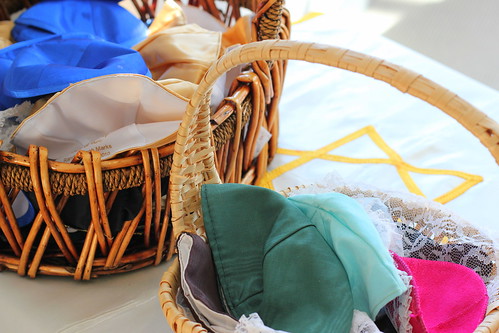
Kippah כִּיפָּה Table at the Synagogue

The kippah is sometimes referred to as the yarmulke. Jews cover their head during prayer, but some Jews always wear something on their head because the Talmud states, "Cover your head in order that the fear of heaven may be upon you."

Thursday, February 24, 2011

Tzedakah Box

"Tzedakah Box"
S. E. Jihad Levine
Copyright 2011, All Rights Reserved

Looks like this tzedakah box in the synagogue was decorated by the children.

We have a sadaqa box in our masjid that was also decorated by the children.  Last year, we donated half the money to the children's wing at our local hospital, and the other half to programs for children at our community's homeless shelter. 

These boxes are in masjids and synagogues so the people can give voluntary charity.

The Jews call them "tzedakah" boxes and the Muslims called them "sadaqa" boxes.

Most Jewish children have tzedakah boxes in their rooms at home.  When it is full, the parents help them to choose a good cause to donate to.

Wednesday, February 23, 2011


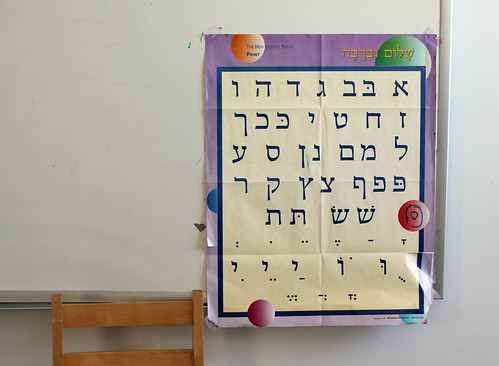
Hebrew Class, originally uploaded by Shaalom2Salaam (Safiyyah).
Copyright 2011 S. E. Jihad Levine, All Rights Reserved
Was at the synagogue yesterday and took some great shots, Masha Allaah. Here's the first of them.

Tuesday, February 22, 2011

"Never Again" ???


Dr. Hajo Meyer, Auschwitz survivor, shares his thoughts about the current moral dilemma the Israeli government, and by extension, the Jewish people, find themselves in ...

Sunday, February 20, 2011

"Sometimes Solidarity Came in Silence"

I'm reading this terrific novel, Sweet Dates in Basra, by Jessica Jiji.

The book starts off in early 1941 Basra, Iraq.

It's written mainly from the point of view of three Iraqi children - Omar (Muslim), Shafiq (Jewish), and Kathmiya (Shia, Marsh Arab).

Omar and Shafiq live along side each other in a house separated only by a wall.  The two families are actually like one despite the differences in religion.

I"m not finished with the book yet to give a proper review, but I am so touched by two of the female characters, Salwa and Reema, that I wanted to share a little about them with you.

Salwa is Omar's mother, and Reema is Shafiq's mother. 

They both gave birth around the same time, so when Reema fell ill, her daughter, Leah, took little Shafiq to Salwa, and she nursed little Shafiq until Reema was well enough to care for him.  "It was one of those when-you-were-a-little-boy stories," Shafiq tells the reader, that he "never tired of hearing ... how he and Omar were christened brothers."

"You were such a part of me then," his mother explained years later.  "Like a little piece that broke off from my body.  All I cared about when I woke up was you.  I was calling out your name even though you were barely half a year old and could never have answered.  My throat was so sore.  I don't know if anyone could even hear me.  But then Leah came over, she put another wet towel on my head and she said, "We brought him to Salwa." 

Omar's mother, the neighbor.

"After I heard Salwa had you," his mother continued, "I could sleep.  I didn't wake up for five days.  The jinn was trying to kill me, trying to get both of us, but it couldn't."

His mother's milk had run dry, but Salwa, who was nursing her own little Omar, saved Shafiq's life.

When Leah first brought her Shafiq, Salwa famously told Omar, "Make some room for your brother."

Salwa never expected Shafiq's mother, without ever having heard those words, to mimic them when she picked him up after the fever broke.  But as soon as Reema scooped up her flowing, sated baby, she said, "Shafiq, you have to leave a little milk for your brother."

So it was that they were and ever would be related.
Subhan'Allah!  In these present days of Islamophobia, anti-semitism, Palestine, Israel, Zionism, and all that - how many Muslim women can make claim to have a CLOSE Jewish woman friend?  How many Jewish women can say they have a CLOSE Muslim woman friend?

How many Muslim or Jewish women can boast of having such solidarity as Reema and Salwa had?  How many Muslim women would so willingly and so selflessly give her breast to a Jewish child?

When Salwa's husband, Hajji Abdullah Abd El Hamid, passed away, it was Reema who was there for her.

For three days following the funeral, the living room in the Abd El Hamid home was transformed into a reception area where visitors streamed in to pay respects. Shafiq and his family joined in bowing their heads and hearing the prayers of the mullah. Roobain (Shafiq's father), who had been to the funerals of other Muslim friends and associates, had explained it all: the special sura they recited from the Koran, the way to bow your head, the chance to reach for the hands of the family. 'But they may not respond and you shouldn't expect them to,' he'd said. 'Sometimes solidarity is louder in silence.'

Reema proved that. Her head covered with a veil, she got up and went to the kitchen, where she stayed for sixteen hours. And returned the next day for longer. And the next. No salt or blue china (for luck and to ward off evil spirits). Just making coffee and cooking meat and chopping vegetables and baking bread and cleaning, cleaning and scrubbing and washing the house so that Salwa, all she had to do was cry.

Sometimes solidarity came in silence. And sometimes in shaking rice in a pan to get all the little pebbles out. Shake, shake, a sound like a rattle, the pebbles separate and the rice is clean.

Shafiq thought of Salwa saving his life when his mother's milk ran dry. She was a widow now, but like Reema, he would never desert her.
I was so touched by that.  I think it's because of what I perceive as the sad and lost relationship between many Muslim and Jewish women today.

How many Jewish women would abandon their own households and families for days to care for their Muslim sister and her family in their time of desperate need? 

Reema did.  In silence.  No one asked her to.  She just knew what she had to do.  For her sister.

Reema and Salwa related to each other as women and friends.  It didn't matter that one was Jewish and the other was Muslim.  Even though the novel is a work of fiction, it wasn't easy for Muslim and Jewish woman in 1940s Iraq.  There was a constant fear that the Nazis would invade Iraq.  There were regular attacks on innocent Jews from certain segments of Iraqi society.  Jewish people were killed and hurt, their homes and businesses destroyed or looted.  Iraqi Jews were voraciously nationalistic and were proud to be Iraqis.  Sadly, as history played out, Iraq eventually did expell its Jewish population.  Today, very few Jews remain in Iraq.

I wonder how the Salwas and Reemas of Iraq dealt with that.  Like their solidarity sometimes came in silence, did it go in silence as well?  I wonder what will happen to Salwa and Reema by the end of this novel.

I read an article not too long ago about a group of Muslim and Jewish women in California who developed a "Cousin's Club."  They meet on a regular basis for sisterhood and solidarity.  During their get togethers, they talk about everything and anything.  They are very close and their relationships are very precious to them.

Our local rabbi is a woman.  This week, Insha Allaah, we are starting a local Cousin's Club.  So far, there's the rabbi, me, and one other Jewish woman.  I pitched the idea to some of the Muslim women at my masjid, and I think some of them may come in time.  But we need to start with just the few of us. 

Well, back to reading ... I'll let you know if the novel's worth the read when I'm finished with it.

Tuesday, February 15, 2011

The Nakba of Arabic Jews...من [جو] [أربيك] النكبة

As Salaamu Alaikum and Greetings of Peace:

I belong to a Face Book group for Jews and Muslims.  As you can imagine, there is a lot of conversation about Gaza, the creation of the State of Israel, etc. 

There is a lot of heated discussion about the perceived ethnic cleansing of Palestinians and their treatment under Israeli occupation, and justice.

One of the Jewish members posted the video below.  I can't stop thinking about it.

As we Muslims express outrage about the treatment of Palestinians in Israel, do we really understand the entire history of the region and the entire scope of the problem?

Are we only looking at the problem through the lens of Muslims?

For true peace to occur in the region, shouldn't we insist upon justice for Jews expelled from Arab lands?  Do these Jews have the "right of return" to Arab lands that we advocate for the Palestinians in the diaspora?

Where is the justice and restitution for BOTH Jews and Arabs in the Middle East?

What do you think?


Tuesday, February 08, 2011

The American Revert's Bathroom!

One of the things that most intrigued me when I came to Islaam is the issue of the bathroom.

I learned that there is a du'a for entering the bathroom:

"[بِسْمِ اللهِ] اللَّهُمَّ إِنِّي أَعُوذُ بِكَ مِنَ الْخُبُْثِ وَالْخَبَائِثِ".

[Bismillaahi] Allaahumma 'innee 'a'oothu bika minal-khubthi walkhabaa'ith.
(Before entering) [In the Name of Allah] . (Then) O Allah , I seek protection in You from the male and female unclean spirits.

Reference: Al-Bukhari 1/45, Muslim 1/283. The addition of Bismillah at its beginning was reported by Said bin Mansur. See Fathul-Bari 1/244

And a du'a for exiting the bathroom:

"غُفْرَانَكَ".

Ghufraanaka
I seek Your forgiveness.

Reference: Abu Dawud, Ibn Majah and At-Tirmithi. An-Nasa'i recorded it in 'Amalul-Yawm wal-Laylah. Also see the checking of Ibn Al-Qayyim's Zadul-Ma'ad, 2/387.

(Above from "Fortress of the Muslim," Darussalam Publications, on IslamicAwareness.net)

There are also rules (etiquettes) for the bathroom.  For example, a Muslim is not supposed to mention the name of Allaah t'ala in the bathroom.  And a Muslim is not supposed to greet another Muslims with "As Salaamu Alaikum" in the bathroom.  A Muslim is not supposed to use the right hand for cleaning the private parts after using the bathroom (and while you're at it, clean three times). And a Muslim is supposed to enter the bathroom with the left foot, and exit the bathroom with the right foot.

The etiquette of the bathroom can be overwhelming to the new Muslim!

In simple Islaamic terms, the bathroom is considered a dirty place.  So much so, that a lot of Muslims run in and out of the bathrooms like someone is chasing them!

It always appalled me to see the condition of some of the bathrooms in our masjids, and in the bathrooms of some of our Muslim businesses: water all over the place, dirty toilets, paper towels (if they have them at all) on the floor, no hand soap, etc. 

And many Muslim homes are no better.  One thing I've noticed is that the bathrooms of most Muslim homes are very simple and inornate.

Sometimes this is a dilemna for the American Muslim because we Americans love our bathrooms!

The average American bathroom is not only a place for relieving yourself and showering; they can serve other purposes.

We Americans like to read in our bathrooms.  Many of us keep books in our bathrooms:


My personal favorite :)


Some Americans like to have plants and pretty things in the bathroom:


Some Americans love fancy handsoaps & handcremes and flowers in their bathrooms:


Last but not least, a lot of us Americans love to take long bubble bath soaks, sometimes with candlelight:


How does a person dash in and out of the American bathroom, lol.  What do you think?

Thursday, February 03, 2011

Childhood Sexual Abuse and Thoughts on Healing

                                                                    Istanbul, 2010
WARNING!  TRIGGER ALERT!

I was reading an article in the December 2010 issue of SISTERS magazine written by Sister Sadaf Farooqi entitled, Swept Under the Carpet.  Sister Sadaf, a homeschooling mom of two "based" in Pakistan, was inspired to write on the topic of sexual abuse of children after hearing about the experiences of some of her close friends.

Like the topic of domestic violence, the topic of sexual abuse of children is difficult for a lot of Muslims to talk about.  After all, we are members of a religion that highly values and respects women and children.  Realistically though ... that's not always the case.

Statistics on sexual abuse among Muslim children are difficult to come by.  Shame, privacy, and secrecy are just a few factors that contribute to the silence.  In some Islaamic cultures, a young Muslim woman's future and marriage prospects are ruined as a result of childhood sexual abuse even though she is a victim and the abuse was not her fault.  After all, Muslims value virginity. 

I congratulate Sister Sadaf for writing this important article, but a few things about it made my blood boil.

If you are a reader of this site, you know that I often disclose that I was sexually abused as a little girl.  I haven't written about it in specific detail, but I have shared the fact that I was abused with you.

I was sexually abused by five different male family members from around age 3 or so until about age 16 or so.  And then there were those family members who were complicit in the abuse because it was right under their noses and they didn't want to know.

The damage done resulted in a very difficult life for me.  I learned real early not to trust adults.  I got the message loud and clear that adults would not help or protect me.  I also learned not to trust men.  I was well into my 40s before I knew how to have a healthy relationship with a man.  Sexual intimacy for me involving taking risks that were terrifying.  Alhamdulillah, I achieved healing from the help of Allaah t'ala and a wonderful therapist that He put in my life. 

In my work as a substance abuse counselor and also in my chaplaincy work, I have counseled many women who have been sexually abused as children.  (Not purposely leaving out little boys here - because they are abused, too, but for purposes of this writing, I am focusing on girls)  As a result, I know a little bit about how to help women through the healing process.  That's why I felt anger when I read the last part of Sister Sadaf's article.

At the end of her wonderful article about how to empower moms to protect their children, she gives "tips" for adults abused as children to try as a "remedy" when they find their past coming back to haunt them:

1.  Talk to a trusted confidante who will keep it secret, perhaps a parent or spouse.

2.  Strive to think about worse things that have happened to other people in this world, as this will develop gratitude for Allah in the heart, instead of rebellion and displeasure with His decree.

3.  Make tremendous du'a to Allah to enable you to forget the incident and also consciously try to forgive the perpetrator.  The power of positive thinking is amazing!

4.  If you can afford to, consult a counselor or therapist.

Okay **taking a deep breath**

First of all, before you leave me a bunch of livid comments, I know that each woman's healing process is different; some women may find Sister Sadaf's "remedies" helpful.  But as a survivor of childhood sexual abuse myself, they provoked an extreme reaction in me.  And I found them over simplistic.

1.  The title of the sister's article suggests that sexual abuse is often the HUGE secret that ruins lives.  So, why would I want to maintain the secrecy and protect the perpetrator after I've finally gotten up the courage to tell someone or once I'm ready to tell someone?  Perhaps I am in the beginning of my healing, and sharing with someone is a start in the process, an exercise in trust, thereby the need to ask the person I tell to keep it a secret.  And we all know that secrets like this can be spread like wildfire in the masjid much to our horror.  But what if the perpetrator is still around?  Worse yet, what if he is a family member?  What if he has small children himself?  Is secrecy wise in this case?  At any rate, do I have to continue to live with the big secret?

2.  Thinking about "worse" things that have happened to other people in the world does not increase my gratitude to Allaah t'ala in this case.  There is nothing more painful for an abused person to endure than to have someone else "minimize" what happened to them by suggesting that they think of other people who have/had it worse.  Your experience is valid.  It was "worse" enough for you!  Acknowledging what happened to you and feeling your emotions does not mean that you need more gratitude in your heart.  Thinking about your abuse does not mean that you are ungrateful to Allaah t'ala.  After all, most abused people have had a lot of experience  thinking of others first before they think of themselves.  That is one way in which a lot of us confuse boundaries.

Giving yourself permission to think about what has happened to you, and focusing on your healing is not rebellious and does not indicate "displeasure" with the decree of Allaah t'ala.  If your past is "coming back to haunt" you, you may be experiencing Post Traumatic Stress Disorder (PTSD).  For that reason, the article should have suggested consulting a professional as the first "remedy."  In a lot of western countries, especially in the United States, there are sometimes programs that a woman can take advantage of that utilize sliding fee scales.  Do not let lack of financial resources keep you back from seeking help.  There are also online help forums, and free help lines in the community that you can explore.  You can also start an anonymous blog and you'll be amazed at the help you'll get from your Muslim sisters.  Online anonymity is a gift.  Ask for help.  Pray for help.  But, get help!

3.  Sister Sadaf suggests that you "make tremendous du'a to Allaah to enable you to forget the incident ... sorry sis.  It doesn't work this way.  Having your innocence stolen is not something you will ever forget.  Having your breasts squeezed and sucked, or if you have no breasts having your nipples rubbed and licked, your private parts probed, your mouth filled with someone's private parts, or your vagina brutally ripped open  are experiences you do not forget.  Having your uncle watch you undress or having your brother grind on you cannot be forgotten.  Giving birth to your father's baby or aborting your teacher's baby ... well, you get the picture.  You can forget your keys, or you can forget an appointment, but it is impossible to forget being sexually molested or raped when you were a child.

4.  She also suggests that you, "consciously try to forgive the perpetrator" with the "power of positive thinking."

In the Qur'an, Allaah t'ala tells us,

"Let them pardon and forgive.  Do you not love that Allaah should forgive you?"  (24:22)

"And verily, whosoever shows patience and forgives, that would truly be from the things recommended by Allaah."  (42:43)

On the surface, you may be thinking that this suggests that you should just "forgive and forget" as the saying goes and as the author of the article appears to be recommending.

But Islaam is also a religion of justice and this deen does not require you to be a doormat for criminals.  Also, your perpetrator has obligation to make tauba, and part of repentance is making restitution to a victim.  So, you are owed.

This is where the patience Allaah t'ala speaks of comes into play.

For you see, there are two kinds of forgiveness in the clinical sense.

a.  You did something to me.  I forgive you.  It's okay.  Let's just forget about it.

b.  You did something to me.  It's not okay.  It's never going to be okay.  I'm never going to forget about it.  But, I'm going to move on.  I'm not letting what you did have any more power over me.  I'm not going to let you continue to abuse me by constantly letting the memory of what you did to me haunt me.  I'm going to heal.

The second item (b) is also forgiveness.  It's a type of commutation.  Kind of like a pardon.  The crime doesn't go away, but the sentence ends.  Part of tauba is for the perpetrator to ask Allaah t'ala for forgiveness.  But when a crime is committed against someone's human rights, the perpetrator must also seek the pardon of the one who he has wronged.  If he does not or cannot get the forgiveness of his victim, Allaah t'ala decides between the two of them on the Judgment Day.

Don't get me wrong:  Allaah t'ala is the Disposer of all affairs.  That is part of Tawheed ar-Rooboobiyah.

If you have been abused, I am suggesting that perhaps once you move through the process of healing you may find yourself in a beautiful spiritual place!  Some women don't totally heal, but some do!

When I started the work of sexual abuse therapy, my counselor told me something that gave me hope and courage to do the work I needed to do.

She told me that the grief, pain, anger, depression, and madness I was feeling then would get better.  She said that I would never forget.  But she promised that one day I would get to a place where my childhood had no power over me.  She said it was like walking through fire.  That it would get worse before it would get better.  She promised me that God would see me through it if I asked Him to help me.  She told me that I'd have to re-live the experience in order to feel all the emotions that I had been stuffing since childhood.  She suggested that this was the language of letting go.

I held on to her promise.

And it worked for me!  My childhood no longer haunts me.  I can talk about what happened to me without emotionally collapsing.  I can share without crying, but the absence of tears does not mean that I am emotionally numb like I once was.  I no longer engage in self-destructive behavior to punish myself.  I can write about it like I'm doing now.  I can try to help other women. 

Most of all, I have the gratitude for Allaah in my heart the the article's author spoke of.

"A woman's psyche may have found its way to the desert out of resonance, or because of past cruelties, or because she was not allowed a larger life above ground.  So often a woman feels then that she lives in an empty place where there is maybe just one cactus with one brilliant red flower on it, and then in every direction, 500 miles of nothing.  But for the woman who will go 501 miles, there is something more.  A small brave house.  An old one.  She has been waiting for you.  (Clarissa Pinkola Estes) 

Tuesday, February 01, 2011

Shalom to Salam

(I wrote this story years ago for Islam Online.  The site has since folded as a result of the controversy when it was taken over in Egypt.  I thought I had posted this to my own blog, but couldn't find it anywhere.  Maybe it is here, but I didn't see it.  Anyhow, I searched the internet and for once was happy about copyright violation!  I tweaked the piece a bit, and Alhamdulillah, I am bringing my Shahadah story home to my own site.)
Shalom to Salam
By S. E. Jihad Levine
(originally at:  http://www.islamonl/ ine.net/servlet/ Satellite? c=Article_ C&cid=%20115607769319 2&pagename=Zone- English-Discover _Islam/DIELayout)

My husband and I had gone to the masjid for a speaker's program. It was the first time that he had invited me to the masjid since our marriage a year or so earlier. We had met and married while we were both working as substance abuser counselors in a rehabilitation center.

We couldn't have been more different in the beginning, as we are from entirely different backgrounds: he is Black and I am White, he is Muslim and I was Jewish. Although he hadn't asked me to become a Muslim prior to our marriage, he did give me silent da`wah by his excellent example.

He had an extensive Islamic library, and because I was an avid reader, I naturally read a lot of his books. I also observed his modest behavior, watched as he made salah five times a day, went to Jumu`ah Prayer on Fridays, and fasted during the month of Ramadan. So it was natural that I would develop an interest in his religion.

When we arrived at the masjid, he pointed out the entrance to the women's section - downstairs in the basement. We agreed to meet in the parking lot after the program was over. "OK, I can do this," I thought to myself as I entered the dark dank hallway and walked down the steep steps.

Since I never had trouble making friends and always enjoyed multicultural situations, I looked forward to the evening.

My husband had suggested that I wear something modest for the occasion. I ran my hands down over my long-sleeved dress, straightening and smoothing it out. I felt confident that the women at the masjid would approve of my appearance.

However, when I arrived at the bottom of the stairs and walked through the door marked "Sisters," I could immediately feel it in the air: thick tension, suspicion, estrangement, and confusion. Every veiled head turned in my direction and the Muslim women stared at me as if I had two heads. I stood frozen in place in the entrance way, staring back at them.

I had never seen so many Muslim women together in one place. Most of them wore the traditional hijab, but two women peered out at me through head coverings that revealed only their eyes. A few others sat with their scarves draped over their shoulders. When they saw me, they pulled them up over their heads.  I was perceived as a stranger.

But then one of them got up from where she was sitting, approached me, and introduced herself as Sister Basimah.  At least this one had a welcoming look on her face.

Hi," I said. "My name is Sharon. I'm here for the speaker's program?"

"Is anyone with you?" she asked.

"My husband is upstairs," I replied.

"Oh! Your husband is Muslim?" she asked.

"Yes. Yes, he is," I said.

"Al-hamdu lillah," she said. "Come over here and sit with us."

She led me to a table where three other women were seated. They were the most beautiful exotic women I had ever seen. Right after she made introductions, I forgot each one of their names, which were equally exotic. Sister Basimah then got up and went to greet more people who had arrived.

"Where are you from?" one of the women asked me. I replied that I was an American of Eastern European heritage, born in New York City.

"Where's your husband from?" was the next question.

"He's from America."

"But where is he from?"

"Philadelphia, " I replied.

"No, I mean, what country is he from?"

"He's American, born in the United States, he's African-American, from Philadelphia, " I replied, thinking that there was a language barrier. I would later learn that most of the Caucasian women in this masjid were married to Arab men.

"Hmmm," they all said in unison and they cast their lovely gazes downward.

"Are you thinking of becoming a Muslim?" another one asked, looking up at me with a beaming expression of hope on her face.

"No," I replied, "I'm Jewish." Well, I wish you could have seen the look on their faces. As soon as it was politely possible, the topic was switched.

"Are your children Muslims?" one of them asked, returning to the interrogation.

"No." I replied, "I don't have any children." That was it; their attempts to find a common ground with me had failed. They smiled at me and then something incredible happened for which I was not prepared: The conversation turned to Arabic.  Just like that - I was locked out.

I continued to sit with them at the table. They mostly spoke to each other in Arabic, and I mostly smiled. As more women would join the table, they would introduce me in English, "This is Sharon. She's Jewish." Then they resumed speaking in Arabic.

Then the program began, the women gathered in the prayer room and everyone sat down on the plush carpeted floor. But after about five minutes, the women started chatting to one another, all but drowning out the sound of the program that was being delivered over a stereo speaker from upstairs.

After the program was over, the women went into the kitchen to prepare food. Sister Basimah came over and told me to sit and make myself comfortable until it was time to eat.

"But let me help you," I offered.

"No! You are our guest. Some American sisters have arrived. I'll introduce you," she replied.

Sister Basimah motioned to one of the women on the other side of the room. She came over and the two women kissed each other on the cheeks and greeted each other with a cheerful Arabic expression.  Then they turned their look on me.

"This is Sharon. She's Jewish. Will you keep her company until we eat?" Sister Basimah said to the other woman.

"Oh, yes!" she replied. "Hi, Sharon, I'm Sister Arwa!"

Sister Arwa and I sat down and began to get acquainted. I asked her questions such as how long she had been a Muslim, whether she was married to a Muslim, etc. Then she dropped the bomb.

"Why did you kill Jesus?" she blurted out.

"What?" I replied. My face must have betrayed my shock and disbelief.

"I mean" she inquired again, this time softening her question, "why did the Jews kill Jesus?"

I couldn't believe what I was hearing! I was astonished and rankled by the question. I could tell by the innocent look on her face that she really wanted to know. Maybe she never met a Jewish woman before, and this was her first real opportunity to get an answer to her burning question.

When I was first introduced to her, I welcomed her company; after all, she was the first American I had seen that evening. Now I wanted to get up and run from the table. Then the anger set in.

Giving her a baleful look, I replied through clenched teeth, "We did not kill Jesus. The Romans did!" She returned the look of a wounded animal. Her lips opened to say something, but before she could reply someone called to her.

"Excuse me," she said, "I'll be back." I could hear the relief in her voice as it trailed off while she quickly escaped from our table.

A group of African-American sisters arrived at the masjid and I spent the remainder of the evening in their company. Before I left to meet my husband, Sister Basimah gave me her telephone number and encouraged me to call and arrange a time to visit with her.

I did call her, and we developed a beautiful relationship. Over the days and weeks that followed, she told me all about Islam and Allah. It was from her that I learned that Muslims believe that no one killed Jesus! I learned that Allah took him up unto Himself.

She sensed that even though I was Jewish, my heart was searching and yearning for spiritual peace. One evening while my husband and I were visiting her home, she came right out and invited me to Islam.

The turning point occurred when she explained that all my sins would be forgiven when I came to Islam. She said that I would be reborn, like a newborn baby, with no sins, with another chance. I broke down and cried.

I wanted another chance to get right with Allah. You see, I had a very checkered past. I always loved God, but I got lost in life. We asked her husband to help me say the Shahadah.

When I told my husband what I was about to do, he was shocked and happy at the same time. He asked me if I was really sure about my decision, as if he couldn't believe what he was hearing. I responded that I was never surer about anything in my entire life. There was no internal battle, no fears or doubts.

After I said the Shahadah, Sister Basimah's husband said, "Mabrook (congratulations) ! You're now a Muslim!" (a line I use to this day when I help sisters say Shahadah).

Before I left Sister Basimah's home that special evening, she gave me a gift of a booklet about modesty for Muslim women. She also gave me a prayer rug, a prayer dress, and a hijab.  When we returned home, my husband gave me a gift of my very own Qur'an and a summarized Sahih al-Bukhari.

I have worn hijab since that day, al-hamdu lillah. I have never taken it off, even after the dreadful days following September 11, 2001.

When I became a Muslim in July of 1998, my father denounced me once and for all. He had been very upset with me anyhow for marrying a Muslim, and refused to recognize my husband as his son-in-law.

"But, Sharon, those people hate us!" he cried.

All efforts to explain the difference between the peaceful religion of Islam and the political struggle between the Palestinians and Israelis fell on deaf ears. Never mind that my father was the first one in his family to marry outside of Judaism. My mother had been a practicing Catholic when they married.

To add insult to injury in my father's eyes, my husband was also African-American. Prior to September 11, 2001, most Americans thought of Malcolm X whenever Islam was mentioned. Many other family members also made it known how disappointed and frustrated they were with my decision to marry a "Black Muslim."

My father died in August of 2001, one month before the events of September 11. At the request of my father's wife, my family did not tell me that he had died until after his funeral was over. Did they fear that I would show up in the synagogue dressed in Muslim garb accompanied by my black husband?

We are taught that the religion of Islam is for all people and for all time. It shouldn't matter whether a Muslim is Egyptian, Pakistani, American, Saudi, Indonesian, Turkish, or Palestinian. It shouldn't matter whether he or she is black, white, red, or yellow. It shouldn't matter whether he or she speaks Arabic, English, Spanish, Turkish, or Urdu. Our cultural diversity should not divide our Ummah. Allah tells us in the Qur'an that (Al-Hujurat 49:13).

"O mankind, indeed We have created you from male and female and made you peoples and tribes that you may know one another ..."

-------

(Update, 2014)  Alhamdulillah, despite all the challenges of cultural differences and family, I am still a Muslim.  I am blessed that my step-mom (Jewish) and brother (Bah'ai) accept me as a Muslim.

I remember visiting my step mom for the first time as a Muslim.  Everywhere we went, she introduced me to her Jewish lady friends with, "This is my daughter, Sharon," or "You remember my daughter, Sharon, don't you?"  Me with my Arabic style jilbab and hijab.  Can you picture it!  She told me she didn't care what religion I was, as long as I loved God and was happy.

I haven't really discussed it too much with my sister (Jewish).  I do remember her asking me if her children, at the time little kids, would be frightened if they saw me in Islamic covering.  I haven't seen my sister in years, and her children are now college age, but I suppose we are at least at the tolerance level. 

My mother (Christian) was deceased by the time I came to Islam.  But, when I would go to Pittsburgh to visit her sister, my aunt (Christian), I am ashamed to say that I took my hijab off before entering her home.  Although this is permissible Islamically because there are no men in her house, I did it for the wrong reasons.  I just didn't want to explain.  I did have on modest clothing with the hijab down around my shoulders and she never asked.  She probably thought it was a fashion accessory as she was always used to me dressing modestly anyhow. 

Finally, I still consider myself an ethnic Jew.  My religion is Islam.  But no one can ever take my ethnic identity away from me.  Most Jews and Muslims don't agree and don't understand, but some do.  What's important is that I do. 

Sunday, January 30, 2011

It is said that physical books are quickly becoming obsolete.

Many people still love the feel of curling up with a cup of coffee (or whatever!) and book in hand.  They love the feel and even smell of a physical book.  Cracking the cover for the first time of a book that arrives in your post is almost a spiritual experience for some people.  Me included!

(An aside: I remember how no one in the house was able to open the newspaper and take anything from it until my father was done with it, or until HE distributed sections to family members.  I always waited for the Comics section.)

Many book lovers adore visiting brick-and-mortar stores like Borders where they can sit in an atmosphere of  book bliss with other book lovers.  Kind of like the atmosphere in a library but only better because no one insists that you be quiet :)

Book lovers insist they will never buy Kindles or other e-readers.

But I wonder if the publishing industry will force people to re-consider their position by making physical books less and less available for purchase. 

Some of you can remember what it was like when music formats changed.  Vinyl record collections and the equipment to play them on became harder and harder to obtain to the point that many record lovers were forced to abandon them for tapes or CDs.  Try to buy a new car with a tape player in it!  Now, most people have digital music collections.

It is predicted that physical books will go the way of the vinyl record in the future.  We will all have a digital book shelf.  I already have one with Kindle and iBooks.  It's so cool to look at your digital book shelf, click on a book cover, and voila, there's your book!  I like that digital books are searchable.  This is especially cool for Qur'an and ahadith collections.  You can even highlight sentences (Gasp!  What will happen to the highlighter pen market?) or bookmark sections (no more dog earred books) so you can go right to them when you need them.  Makes reference and research a whole lot easier.  So, e-books and e-readers do have some benefit.  But I don't want to read literature or poetry in e-format.

Part of the pressure for society to move toward the e-book format comes from the publishing companies who are making it more prohibitive for authors to publish their work in physical book form and still make a profit.  Everyone profits from an author's work except the author.  Print-on-demand publishing can also be financially prohibitive.

As a writer, I know all this and don't have the patience or finances for it.  That's why I do the majority of my writing right here on my own website.  I also ordered the book pictured in the beginning of this piece.  I may try my hand at making books.  I do collage occasionally and have a lot of cool papers and other materials.

For me, writing is not a commercial venture.  But for those writers who write books and want to make money, too, I can understand.  Some writers don't mind having their book published in e-format, but many would rather have their book come out in one or more other formats so that there is choice for the consumer.

Choice is becoming obsolete for readers, too.

Let me give you an example.

I bought the e-book, The Seventh Telling: The Kabbalah of Moshe Katan for a class at the Spiritual Care Center of our local hospital.  The author is Mitchell Chefitz.  This work, is the first in a trilogy by Chefitz.  In it, he uses fiction to teach kabbalistic themes.  I initially purchased the book as an e-book because I am always a little wary of buying "textbooks" and then being stuck with them.  Between my husband and me, we have zillions of books, Masha Allaah, so book shelf space in our house is at a premium.

But I loved The Seventh Telling and learned so much from it.  I wanted the physical book, so I purchased a hardback.  I was then eager for the second work in the trilogy. 

I was able to purchase a hardback copy of the second work in the trilogy is The Thirty-Third Hour which uses fiction to teach Torah themes.  Read it.  Loved it!

Since The Thirty-Third Hour was published in 2002, I thought that surely the third and final book in the trilogy would be out.  But alas, I searched and searched and couldn't find anything online about it.

So, I had the brilliant idea to search for the author on Facebook and Alhamdulillah I found him!

I sent him a private message, asking about the final book in the trilogy.

He responded and told me that the third book would be out soon, BUT it would only be available as an e-book.  Oh wow!  Was I bummed!

How can I put an e-book on my library shelf along side of The Seventh Telling and The Thirty-Third Hour?!I can guarantee you that it will do something to my spirit to see the space on my shelf that this e-book will create.

I wrote Mr. Chefitz and told him this.  He responded that if the e-book does well, physical publication may be a possibility in the future.  (St. Martin's Press published the first two books in the trilogy, not sure why they won't/can't publish the third one unless it is Chefitz' decision.)

But *whaaaaa*  I want the hardback copy!  What upsets me is that I won't have a choice.

I don't like not having choices.

Tuesday, January 25, 2011

Big, Bad, Blonde Shiksa - Part 2

Continued ...

So, I returned to Judaism.  I started to take classes and establish relationships at the local reform temple.  Oddly, my mother didn't try to stop me.  I remember my Jewish grandfather calling my rabbi to explain the details of my situation so the rabbi could understand it all better.  The rabbi later told me that my grandfather pleaded with him to take care of me and look out for me.  (I am crying as I write this!)  I was grandpa's little girl.  I was the first Jewish grandchild in the family.  You can imagine ...

Well, getting back to my mother.

I used to hate my mother.  I had NUMEROUS issues with her.  Only waaay later in life did I forgive her and come to understand and feel compassion for her, her life, and her choices.

My mother loved my father until the day she died.  She wouldn't admit it, but she did.  Sometimes I would wake up in the middle of the night and hear her crying while she was drunk, talking to one of her friends long-distance, talking about my dad.  She kept pictures of him (which I now have) and maintained a relationship with my grandparents until they passed away. 

Did she change herself much or her identity in order to be married to a Jewish man? 

I do remember how her speech was peppered with Yiddish words until the day she died.

And she could cook a Jewish pot roast that was right up there with that of both my Jewish grandmother and Jewish great grandmother. 

In the beginning, she tried to keep a kosher kitchen, but as I mentioned in Part 1, it didn't work out too well :)

She agreed to raise her children Jewish, which is HUGE for a believing Catholic woman.

She kept the name "Levine" until she married my step father.  And despite making us Catholics, she didn't attempt to change our names.

All this in a post World War II America.  And after all that, she ended up divorced anyway. 

Hmmm ...

Well, time for some photos:

Here's a Valentine's Day card my father sent to my mother.  After she died, I found it in her drawer where she kept all her treasured memories.  The middle is made of satin cushion:


Here's a picture of my dad and a few of his service buddies.  My dad is the one kneeling down in the foreground. 
My dad's aunt, uncle, and grandparents.  Aunt Julia is in the back.  My great grandparents Jake and Fanny are in the middle, and Uncle Sammy is in the foreground, sometime in the 1940s.
My father and stepmom when they got married.


Another image of my dad.


My parents on one of their trips to Pennsylvania:

My mom holding my brother, and my dad and me:


Monday, January 24, 2011

Big, Bad, Blonde Shiksa - Part 1

There's a great conversation going on over at Lucky Fatima's blog, inspired by another one at the Big, Bad, Blonde Bahu Blog, having to do with mixed religious, cultural, and racial marriages, and the phenomenon of the wife (usually, not the husband) taking on aspects of her husband's religion, culture, and race.  In many cases, the wife ends up being a wanna-be fill in the blank (Arab, Pakistani, etc.)

She often starts to dress like the people of her husband's culture, learns his language, cooks the food of his country, and may even convert to his religion.  The people of her husband's culture may find this a curious thing.  Often, despite all her efforts, the wife never becomes fully accepted by her husband's side.  And worse yet for some women, she may lose herself and her own culture completely. 

Unfortunately, many wives experience this transition with identity issues.  If you read through the two posts mentioned above, you'll get a better idea of what I'm talking about.

Since I was born into a mixed religious and cultural family, I thought I'd throw one of my hijabs into the ring and write about the "shiksa."  (Thanks Fatima!)

The word "shiksa" has Yiddish and Polish origins.  It is derived from the Hebrew word, "sheketz," which loosely translated is the flesh of an animal deemed taboo by the Torah.  Most Jewish people in America understand the "shiksa" to be a non Jewish woman.  It can also refer to a non Jewish woman who has attracted the attention of a Jewish man.  Sometimes, Jewish women refer to their non Jewish household help as "shiksa."  The Urban Dictionary has a great description of the "shiksa" here.  (Warning: some readers may find the language offensive.)

Most of the time, "shiksa" is used in the derogatory sense.  It is an insulting and offensive word.  The "shiksa" is not a woman of valor.  She is despised, especially by other Jewish women, because somehow she has managed to snare an otherwise-good-Jewish boy.  Especially nowadays.  Many unmarried Jewish women claim it is difficult to find a nice Jewish husband.  So it adds insult to injury when Jewish men marry "shiksas."  Even if the "shiksa" converts to Judaism, it is still a sore spot for many Jewish people.

My mother was a "shiksa."  She was a tall, big-boned, blue-eyed, Polish, Catholic, blond woman.  A "big, bad, blonde shiksa."  My father in turn was an olive-skinned, black hair, dark brown eyed, Russian/Austrian Jew.  Looking at pictures of him when he was a young man, I can see how my mom would have found him tall, dark, handsome, and exotic.

They met after the end of World War II in New York City where they had both been serving in the US Military.

The story goes that my mom and some of her Army girlfriends were partying in a bar when they saw a bunch of handsome Navy guys.  The two groups got together and my parents were immediately attracted to each other.  After a bunch of drinks, issues like religion and culture were the last things on their minds. 

My parents were madly in love.  At the time, my father's people, Eastern European immigrants, were also living in New York City.  Since my dad loved my mom so much, his family worked real hard at accepting the new "shiksa" addition to the family.  They tried real hard to teach my mom about Jewish traditions.  For example, my great-grandmother Fanny explained to my mom all the ins and outs of the kosher kitchen. But my mom had problems getting it straight, and often mixed up the dishes and pots. Grandma Fanny finally gave up and solved the problem by finding excuses to keep my mom out of her kitchen.

My mom had no intention of giving up her religion.  And my father didn't expect her to, nor did he ask her to convert to Judaism.  As most newlyweds do, my parents thought that their love could see them through anything.  They mutually decided to celebrate the religious holidays of both of their faiths.  So.  They had Christmas and Hanukkah.  Easter and Passover.  You get the idea.  However, once my brother and I came along, it was decided that we were to be raised as Jewish children.  I'm not sure who did the deciding.  Was it my father?  Did my mom agree in order to keep family peace?  Was it okay to have a "shiksa" in the family as long as her children were Jewish?  And how did that work since religion passes through the mother in Judaism?  Did my mother secretly convert?  Anyhow, we always identified ourselves as Jewish.  I remember going to the synagogue with my father and grandfather, but my mom never went.  My brother and I knew our mother was not Jewish.  Somehow, it was no big deal.

My maternal grandmother, my mom's mother, on the other hand HATED my father.  She used to spit on the floor every time his name was mentioned.  We used to travel to Pennsylvania from New York City once a year to see my mother's family (also immigrants).  No one else in the family had a problem with my dad except my grandmother.  For that reason, she tolerated him while they visited, but she made it real clear that she did not like him or accept him.  My father tolerated it all with his classic humor.  After all, Grandma hated her son Tony's wife, too, because she was an Italian.  In those days, Poles and Italians did not intermarry either.  So Uncle Tony and my dad became great pals until the day I told my dad that my Uncle Tony had been sexually molesting me.

In my dad's family, he was the first one to marry outside of Judaism.  He wouldn't be the last though.

Looking back, I can now understand how difficult it was for my parents.  We're talking about the early 1950s.  At that time, Jews were not accepted in America like they are today.

In the end, the differences played a role in destroying their marriage.  What really devastated my mother was the discovery that my father was cheating on her.  With a Jewish woman.  After the divorce from his "shiksa," my father married his Jewish girlfriend.  He then had a 100% Jewish family.  He might have been able to chalk off the whole memory of his "shiksa," except for two small details:  my brother and me.

My mother never forgave me for not telling her that my dad had a girlfriend.  WTF!  I was about 11 years old.  My dad used to take us on weekends to visit our grandparents, and a lot of times, she was there.  I thought she was an aunt or cousin or someone like that.  What did I know?  Well, for sure, I knew she was nice and loving to me.  By this time, my mother's alcoholism was in full swing and you can imagine everything that went along with that.

My stepmother and father also eventually divorced.  But to this day, and I am almost 62 years old, my stepmother and I are very close.  I call her "mom" (my mother is deceased; used to call her "ma") and cannot imagine my life without her.  She has always been there for me, and she introduces me to everyone as "my daughter." 

As soon as my mother returned to her family in Pennsylvania, she stuck my brother and me in a Catholic school.  I was about 12 years old at the time and my brother was about 8.  We had no choice in it.  Anyone who is familiar with my blogging knows how I suffered until I was old enough to make my own decision to return to Judaism.  On one hand, I found comfort in the physical presence of the Catholic church:  the candlelight, stained glass windows, smell of incense, Latin chanting, etc.  But I had a solid Jewish education:  I could not reconcile Isa (Jesus), peace on him, with being the Almighty G-d.  Nor could the church convince me that G-d was part of a Trinity or that He had a son.

(I'm writing this in two parts because I hit "Publish Post" before I was done with it.  Oi vey.  Part 2 to come tonight or tomorrow Insha Allaah.)

Monday, January 17, 2011

Martin Luther King: "The Montgomery Story" Comic


The original comic book, The Montgomery Story, has been translated into Farsi and Arabic.  Many people in the Middle East have now read it and learned the wonderful story of Martin Luther King, Jr., and the Civil Rights struggle.

You can read it online here in the original English and/or download the comic in all three languages to your computer.

Tuesday, January 11, 2011

Old San Juan, Puerto Rico, Chapel


I'm starting to go through old pictures from various film cameras I've owned during the last 40 years.  Wow!  I've been into photography that long!?

I've started to scan them because, in many cases, I've lost the negatives.  I have boxes and boxes of pictures. 

So, I should have fun over the next few months (or years, lol). 

If anyone knows the name of this chapel, please let me know.  It's in Old San Juan, Puerto Rico, near the waterfront.  I don't think it's the Capillo del Christo, but I remember it was somewhere near the Parque de las Palomas. 

Makes me want to return now that I have a nice DSLR camera.

Sunday, January 09, 2011

Cat Toys for the iPad

 Alhamdulillah, I found this wonderful toy in the App Store for cats called Cat Toys.

My cats absolutely love it.  It's even a lot of fun for me to watch them play with it.  They wack and bat the heck out of the iPad screen, so be sure that you have one of the screen sheet protectors over your iPad, and cut your cat's nails often (which you should do anyway). 

Now if only I could get my iPad back.  Everytime I pull it out to use, my cats are right on top of it. 

Here are a few shots of my oldest male cat using "his" iPad!

Thursday, January 06, 2011

"Birdie Cupcakes"

Copyright © 2011 S. E. Jihad Levine, All Rights Reserved


Been fooling around with food photography. Not as easy as you'd think!

Anyhow, my neighbor brought these over. I am blessed to have neighbors who love gardening, gardens, and all who visit them.

Recipe for these birdie cakes is here.
Make some for your backyard friends and receive ajr at the same time.


Thursday, December 23, 2010

Jumuah Mubarak!


Amaryllis Blossom on Sunporch
(Copyright © 2010 S. E. Jihad Levine, All Rights Reserved)
How Perfect is Allaah t'ala, Creator and Sustainer of Everything ... Jumuah Mubarak Everyone!

Wednesday, December 15, 2010

Arabian Perfumes


   Copyright © 2010 S. E. Jihad Levine, All Rights Reserved

Wednesday, December 08, 2010

Memory Lane ... The Projects

As Salaamu Alaikum and Greetings of Peace:

Insha Allaah this finds you all and yours well!  How is everyone coping with the upcoming Winter?

Me, in addition to my usual complaints, Alhamdulillah, I've been dealing with severe pain in my wrists and fingers.  Haven't been doing too much online except commenting on blogs here and there, and updating/venting on Face Book ...

I've been reading a lot, but I've also been a lot busier than I like to be.  Since retirement, I have enjoyed doing exactly what I want to do and not what others want me to do.  At this point in my life, my constant reflection is on my akhirah.  Approaching old age is an opportunity from Allaah t'ala to catch up, do things one has always wanted to do but never had time for, and most of all ... an opportunity for good deeds and tauba.

I went to Pittsburgh last week for a business meeting.  I used to live there from about age 11 or so until my early 20s.  So, there are many traces and tracks of me there.  It's been at least 10 years or so since I last visited Pittsburgh.  While there, I visited the graves of my family.  After that, I decided to go down Memory Lane.

Someone told me that the old housing project where I used to live is no more.  Because it had became so crime and drug infested, the government tore it down.  At one time, there were 20 buildings there.  We used to live in 17G.  Strange how those kinds of details stick with a person.

A lot of the old housing projects in America were originally built as housing for veterans returning home from World War II.  Once the veterans got situated and on their feet, the government converted them into low income housing.

Our entire project was situated around an oval road.  And the road is all that remains of the lives of the people who had lived there.  Grass and weeds now replace the row houses.  It was so weird to drive my car around the oval, remembering where everything and everyone used to be.

I was practically born and raised in the projects.

The first one was in the Bronx.  Today the area is called Harlem, but it was the Bronx back then (the 1940s).  The hospital where I was born, Bronx Hospital, is no longer there.  We used to live in a high rise on E. 113th St. and 3rd Avenue.  I remember trying to visit the building while on a "tour" of New York City with an Urban Sociology class in college.  But, our class couldn't get past the drug dealer who stood sentry in the entry foyer.  Because they do business in the foyers and stairwells of the high rises, the punk wouldn't let anyone in who wasn't a resident of the building.  One wonders how people live like that.  But then again, the fear of the building residents and the lack of protection by the city both play into the condition there.

When I was about 4 years old, we moved from the Bronx to Chicago - for a better life.  All of us went except for some of my great aunts/uncles and my great grandparents.  A few of my great grandparents' children stayed there to look after them.  They didn't want to leave New York City, the place they immigrated to from the "old country."

I still can remember the caravan to Chicago:  my paternal grandparents, my aunt and her kids, and my parents and us.  We lived there until my parents got divorced when I was 11 years old or so.  That's when we moved to Pittsburgh to live near my mother's people.

After a short stay with my maternal grandmother, she kicked us out.  My mother was an alcoholic, and one alcoholic in the house (my grandfather) was enough for my grandmother.

So, we went to stay in the projects with one of my aunts, my mom's sister.  She had a three bedroom place for herself, her daughter, and her five sons.  Once we got there, we were two adults and eight children living in a three bedroom place.

My mom and my aunt slept in one room.  The little kids slept in the other room.  And us four older kids slept in another room.  As one of the older kids, I slept in a bedroom with three of my older cousins. 

It was in that room where I was sexually molested by my two older cousins while the one who was my age watched.

It wasn't the first time ... actually the first time was by an uncle when I was about three years old.

After a few months, we got our own place in the projects.

A lot of people reflect on the negatives of project life, but there were also a lot of positives. 

First of all, everyone knew everyone.  And everyone knew everything about everyone.  It's impossible to maintain total privacy in the projects.  If you try, people will put their heads together and make up stuff about you.

Domestic violence, divorce, rape, child abuse, alcoholism, poverty, and much more ... it was all there.

So was love and friendship.  And camaraderie.  It wasn't all bad.

I remember us all going down to the township building to stand in line to collect our allotment of surplus food - flour, sugar, lard (!), pasta, powdered eggs, butter, cheese ... the best part was when we got home and our neighbor, Mrs. Berger, used to make cakes from her supplies.  There was always cake in her home!  Her specialty was chocolate mayonnaise cake.  She always gave every kid in the project who came to her house pastries.

It was in the projects where I watched the Beatles perform on the Ed Sullivan show.

Most of all, I remember that my mother always thought that we were better than everyone else.  She always held on to the fantasy that we were different from everyone else, that we were only there temporarily, that we weren't like the rest of the residents there, that the projects wasn't our lifestyle ... she was bound to get us out someday.

And get us out she did.  She got married to a wonderful man who took us out of there and bought us a real house in a real neighborhood. 

So I guess in the end it seems like a fairy tale ending.  It wasn't.  But, I guess that chapter of my life ended up well.